
Cannon Dancer / Osman Review
Cannon Dancer / Osman was created as a kind of spiritual successor to Strider and there’s definitely a lot of Strider’s DNA present in the game design, but I would say that is low-hanging fruit for comparison and would instead liken the game to the 1993 Super Nintendo game Run Saber, seriously check out Run Saber if you haven’t, it’s great!
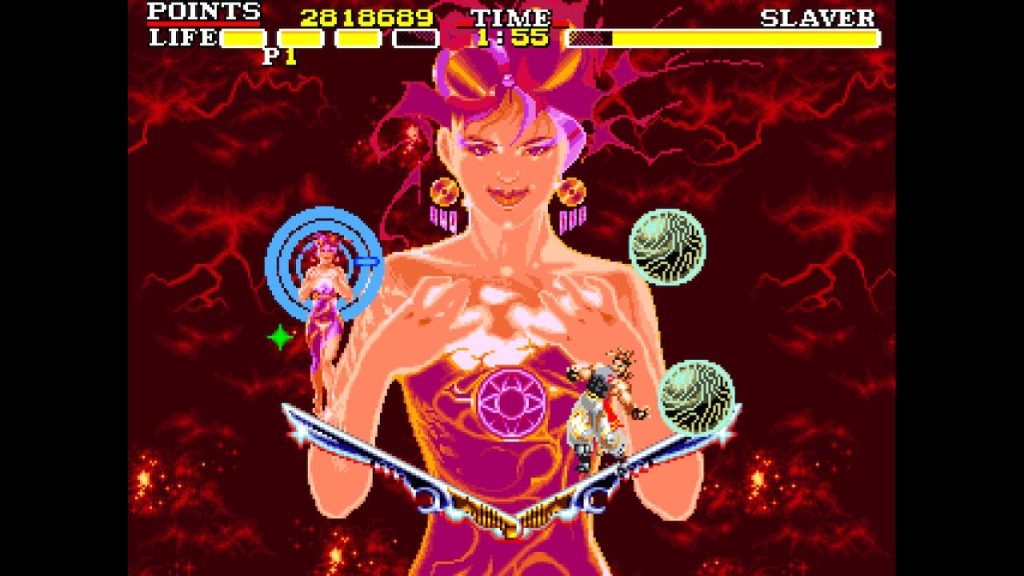
Cannon Dancer does away with the futuristic aesthetic of Run Saber and the Soviet theming of Strider and has a setting I would describe as Arabian Cyberpunk. It’s for sure a lot more colourful than those previously mentioned games and has varied level and enemy designs. You control Kirin, a martial artist tasked with taking down the evil sorceress Abdullah the Slaver who threatens to take over the world.
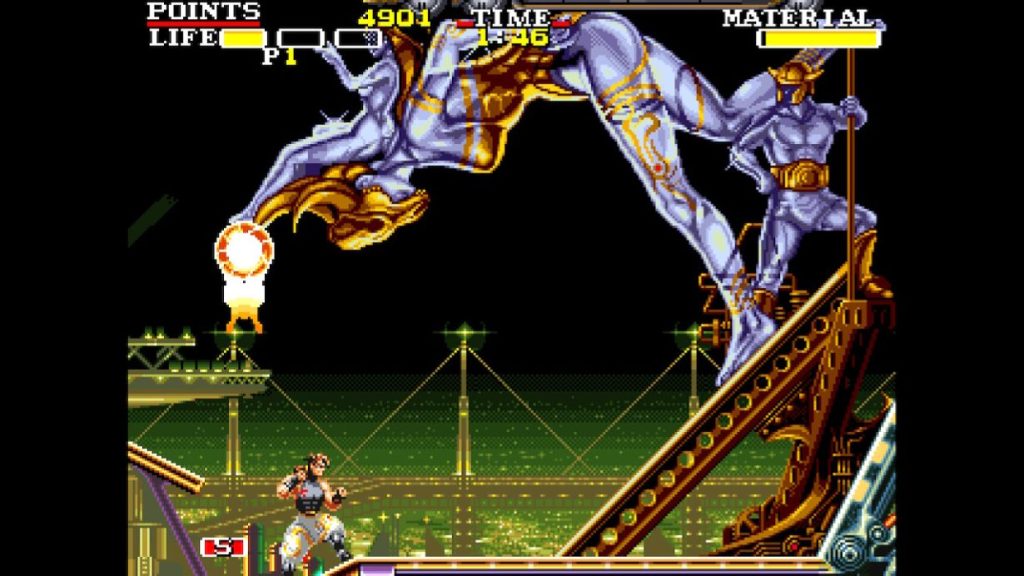
Unlike the two protagonists from Run Saber or the main character Hiryu from Strider, Kirin doesn’t use weapons at all instead opting to use a mix of martial arts and acrobatics to take down foes. Controls are simple enough with a button for a Standard attack, one for jumping and another for a special attack. Like in Run Saber and Strider, our protagonist can grapple walls and ceilings with ease, a skill that becomes essential in the game’s later few stages.
Power-ups are littered generously throughout Cannon Dancer mainly being either red or green in colour, with red increasing the attack power and green restoring health. You can visually check which power level you are currently playing at by the colour of Kirin’s pants, no really I kid you not.
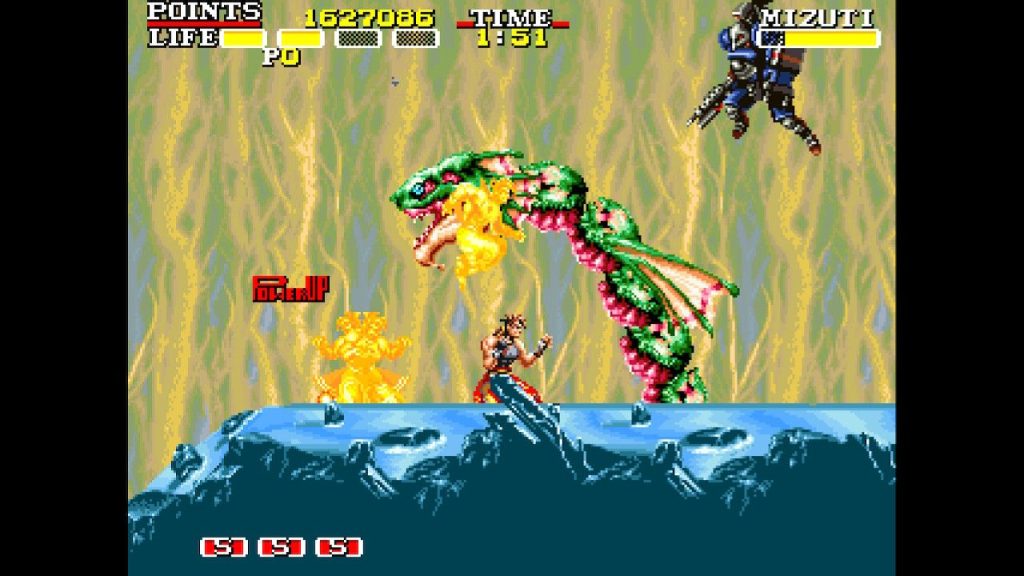
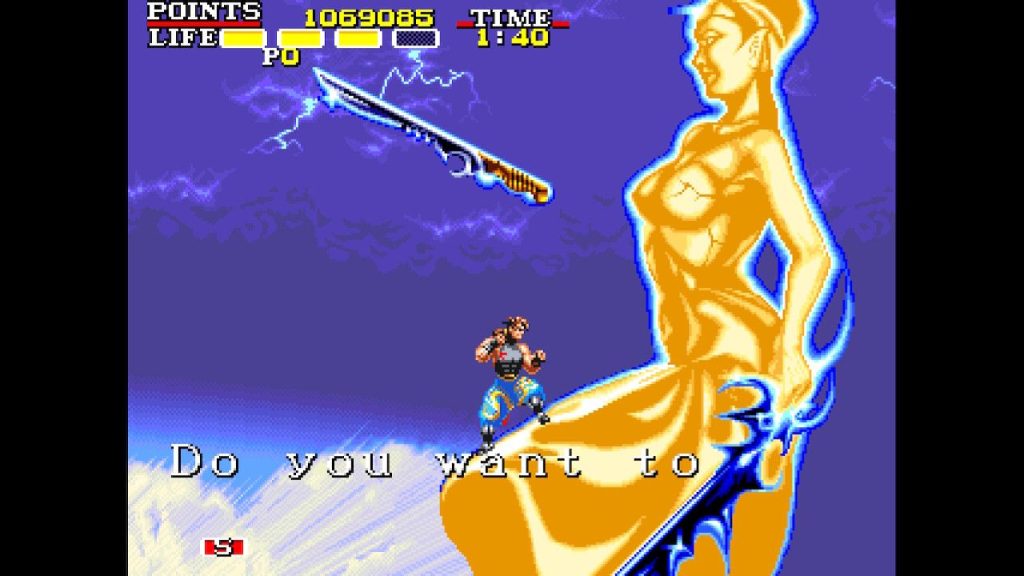
The different levels of Pant colour denote Kirin’s current ability set with the default being blue, after collecting a power-up they will change to purple which allows for an after image to be created mimicking Kirin’s attacks. The next collected power-up will turn the pants red allowing for another after-image followed by a total of four after images with the next power-up denoted by white pants. The final power-up changes the pants black and increases Kirin’s attack and range which is essential for some of the late-game bosses.
In terms of difficulty, Cannon Dancer is not too punishing for an arcade game until the fifth level where there seems to be a massive spike which lasts until the end of the game (Level 6). I honestly dread to think how much money the original arcade machine extracted from players back in the 90s. Luckily, after losing a life, you are placed back in the action, instead of a checkpoint system with a full special attack meter, meaning you can pretty much just spam that attack to kill a boss in three hits.
The only somewhat weird anomaly is the final level which is the only one to include a checkpoint-style system which I guess does make sense as it is essentially a boss rush with the final boss at the end.
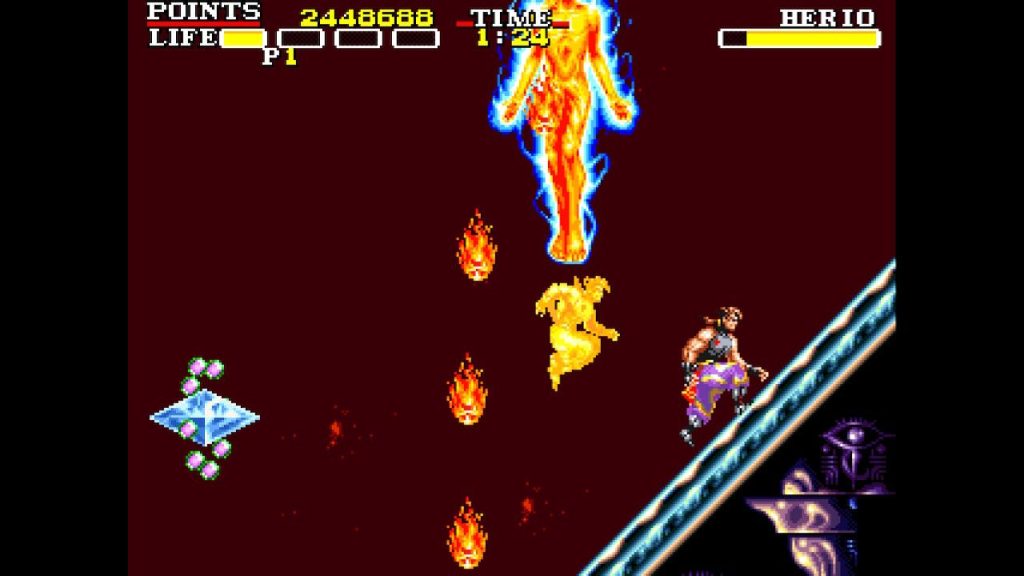
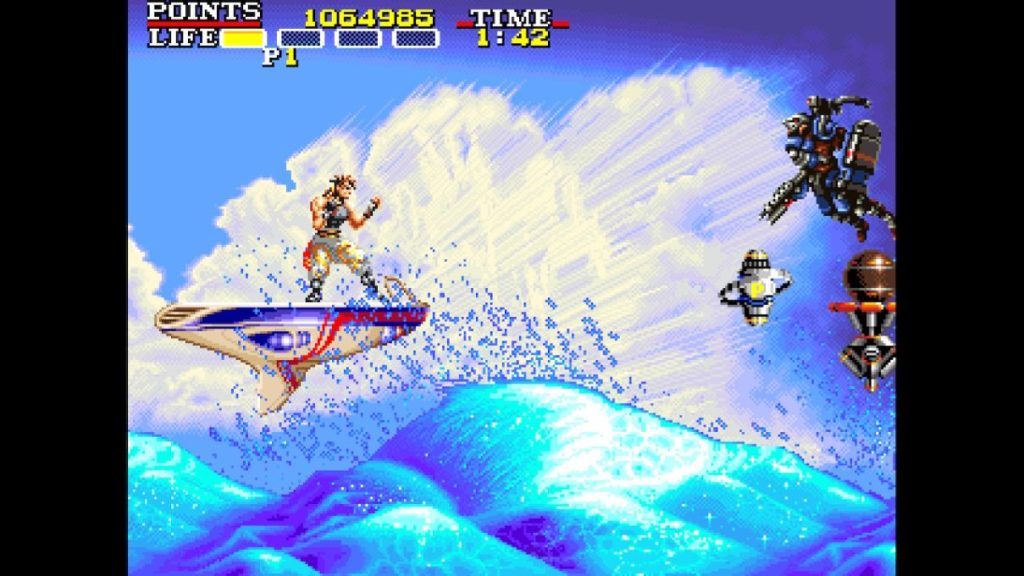
The art style in Cannon Dancer is really nice, it’s bright and makes good use of colour. There are a lot of orange and red hues in the game offset by a few sections of bright, vibrant blue skies etc. It is a really good-looking game and there’s even some Sega Saturn-esque transparency and dithering in certain areas such as explosions or going through clouds. The boss sprites in particular are very well designed and can be quite large which I always appreciate in these types of games.
Just as with the previously released Wonder Boy Anniversary and Ninja JaJaMaru Collections, the porting is handled by Ratalaika Games and as such, the features and menu templates are very similar. The package includes various video filters including a CRT filter if you want to make Osman and Cannon Dancer look a little more authentic like their arcade counterparts.
There’s a fast forward and rewind feature which is great for learning some of the enemy patterns as well as a rather generous 6 save state slots included per game.
There are two modes for each version of the game, Standard mode allows you to use all the quality of life features, the aforementioned Save States, Rewind and cheat features at the cost of not being able to unlock achievements and trophies etc. If you want unlockables and a true test of your Cannon Dance skills you’ll need to choose Challenge mode. This is a fair solution to dishing out achievements in my opinion and will be the mode that keeps players returning to see what accolades they can unlock and brag about among friends and Twitter.
The main gripe I have with this collection is the fact it’s essentially one game with an additional language option. For this review, I completed both Osman and Cannon Dancer back to back and as far as I can tell they are pretty much identical apart from Cannon Dancer being in Japanese. Being an arcade game, a playthrough will take you around 30 minutes once you know what you are doing and have studied some of the enemy attack patterns, which is to be expected but I just wish there was a little more to the collection.
Conclusion
In conclusion, Cannon Dancer is a challenging arcade game with a beautiful presentation and I am glad to see it get the recognition it deserves in this collection. That said, the collection is a little bare-bone and is only essentially one game with two included modes. While this is a great game, I would have liked to have seen a little more added to the package, be it an additional exclusive level or even some concept art.
7
Nintendo Switch review code kindly provided by ININ Games